Cold plunge vs ice bath: what changes
A cold plunge holds its temperature with a chiller; an ice bath drifts as the ice melts. The ice math, the cost per session, and who each one actually suits.
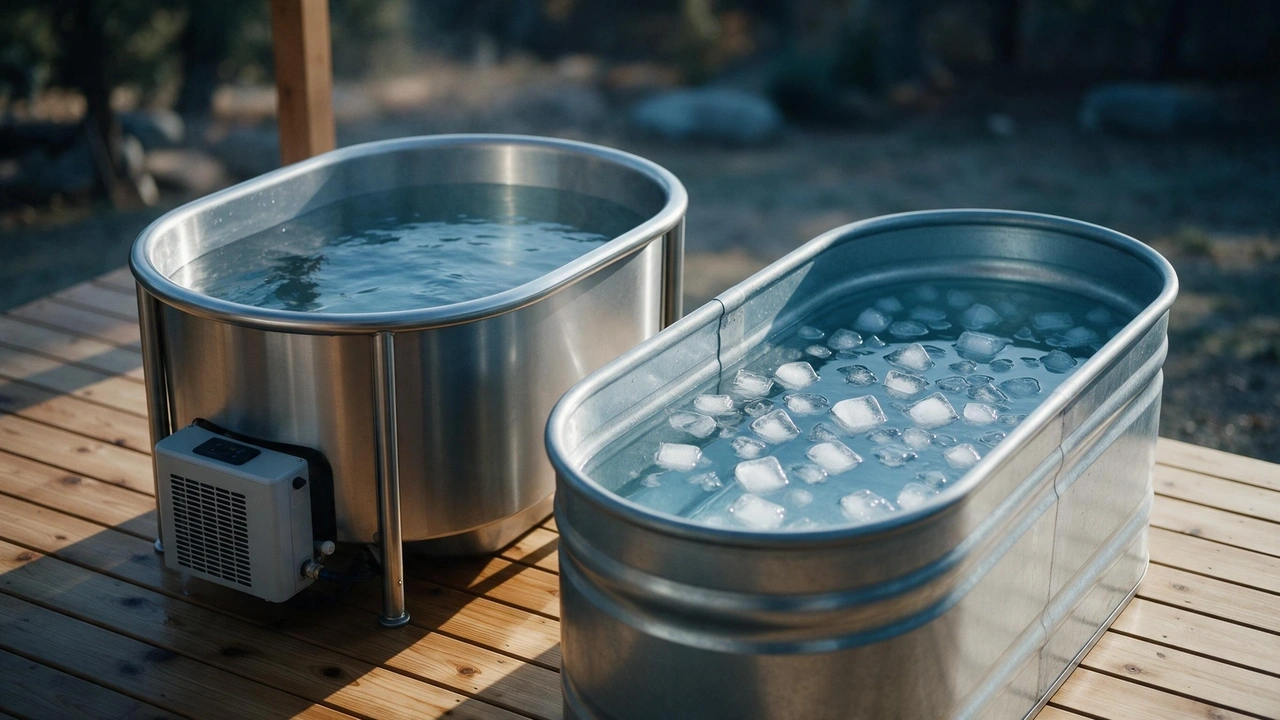
A cold plunge holds a set temperature with a chiller and filtration; an ice bath starts cold and warms as the ice melts. About 100 pounds of ice moves a 100-gallon tub 12–14°F in a warm garage, for $25–$60.
- Temperature control
- Chiller holds ±1–2°F; ice bath drifts upward
- Ice for a 20°F drop
- About 100 lb per 100 gallons
- Cost per session
- Ice bath $15–$60; plunge $0.70–$1.30
- Setup cost
- Ice bath $80–$300; plunge $1,500–$6,000
- Best for
- Ice bath: occasional. Plunge: daily
Some links on this page are affiliate links.If you buy through them we may earn a commission at no extra cost to you. We do not accept payment for rankings. Read the full disclosure.
| Ice bath | Cold plunge | |
|---|---|---|
| Temperature | Starts at 45–50°F, warms through the session | Held at the setpoint, ±1–2°F |
| Cost to run | $15–$60 per session in ice | $250–$450 per year in electricity |
| Water care | Drain and refill after each use | Filtered, sanitized, tested weekly |
| Setup | Tub, hose, ice | Tub, chiller, pump, filter, circuit |
| Time per session | 20–40 minutes of prep | 2–5 minutes |
| Best for | Occasional use, renters, no outdoor power | Daily use at a fixed location |
An ice bath is a tub with ice in it. A cold plunge is a tub with a chiller, a pump, and a filter holding the water at a set temperature. The purchase price differs by a factor of ten, and the running cost runs the other way.
A cold plunge is a maintained water system held at a target temperature, usually 40–50°F, with refrigeration and circulation. An ice bath is a single thermal event: fill a tub, add ice, get in before it melts, drain it afterward.
Temperature is the whole argument
A chiller holds a setpoint within 1–2°F. That stability is the product. You open the lid, the water is 45°F, and it is 45°F for the next person an hour later.
An ice bath follows a curve. You dump ice into 70°F tap water, stir it, and watch a thermometer. The first plunge might be 48°F. Ten minutes later the water near the surface has warmed, the ice is floating in a layer instead of mixing, and the reading is 55°F. You are managing a slope, not a temperature.
There is a plumbing detail hidden in that curve. Ice displaces water the moment it goes in. One hundred pounds of ice takes up about 12 gallons of volume, so a 100-gallon tub filled to the rim will overflow before it gets cold. Fill to 85% and accept a shallower soak, or buy a bigger tub than you think you need.
The ice math
The arithmetic is not mysterious. Melting one pound of ice absorbs about 144 BTU. Warming that meltwater the rest of the way adds a little more. A gallon of water weighs 8.34 pounds, so a 100-gallon tub holds 834 pounds of water, and every 1°F of cooling removes 834 BTU.
| Ice added | BTU absorbed | Drop in 100 gal, theory | Realistic, 90°F garage |
|---|---|---|---|
| 10 lb | 1,600 | 1.9°F | about 1°F |
| 20 lb | 3,200 | 3.8°F | 2–3°F |
| 50 lb | 8,000 | 9.6°F | 6–7°F |
| 100 lb | 16,000 | 19°F | 12–14°F |
| 150 lb | 24,000 | 29°F | 18–20°F |
The realistic column assumes 25–30% of the cooling is lost to the tub shell, the ground, and warm air. That is why a 20-pound bag from the gas station does almost nothing: it buys 3–4°F on paper and 2°F in practice.
One hundred pounds is the real unit of work. It is also five 20-pound bags, two coolers, and a car trip.
What the ice costs over a year
Bagged ice runs about $0.25–$0.60 per pound depending on the store and the season. A single 100-pound chill is $25–$60. Top-ups after a session add 20–40 pounds, or $5–$24.
Annualize it two ways. Dump and refill every day at 100 pounds: 36,500 pounds a year, or $9,100–$21,900. Keep the tub and add 25 pounds a day: 9,125 pounds, or $2,300–$5,500. A chest freezer can turn out roughly 10–20 pounds a day if you give it the space, which lowers the cost but not the logistics.
A chiller running 500 watts for eight hours a day uses 4 kWh. At $0.17 per kWh that is $248 a year; a bigger unit in a hot garage lands nearer $450. The full arithmetic is in cold plunge electricity cost.
At daily use, the chiller pays for itself in one to two seasons. At twice a week, it does not.
Sanitation: ice is not a sanitizer
An ice bath has no circulation, no filter, and no residual disinfectant. The water sits at 45–60°F, which slows bacterial growth without stopping it, and it collects sweat, skin cells, and whatever was on your feet. Draining after each session is the only reliable answer.
A cold plunge is a small pool. It needs a pump, a filter, and a sanitizer, and the water needs testing. Cold water does not exempt you from the chemistry; it just makes the chemistry slower and easier to neglect. The maintenance routine is in cold plunge water care, and the general principles are the same ones the CDC publishes for treated recreational water.
Do not share an ice bath. A cold plunge with properly maintained water is the shared option.
Convenience is the underrated difference
The ice bath ritual is 20–40 minutes of work before you get wet: drive, buy, haul, dump, stir, wait, then drain and wipe a heavy tub. That is fine on a Saturday. It is a poor fit for a 6 a.m. session in February.
A cold plunge is a lid and a step. The chiller runs in the background, the cover keeps the leaves out, and the session is over in five minutes. The friction is the feature. Most people who stop using an ice bath stop because of the prep, not the cold.
Skin contact and time in the water
Ice cubes touch skin directly, which produces a sharp, local sting and a numb patch where the ice rests. The water around your body is not uniformly cold, and people tend to get out early.
A chilled tub with a circulating pump moves water past the skin, so heat leaves more evenly and the cold feels deeper at the same temperature. That is convection, not a health claim.
Most sessions run two to ten minutes either way. Cold water stresses the cardiovascular system, and the response is stronger when you are unprepared. Talk to a clinician if you have a cardiovascular condition, and never plunge alone in open water.
Who each one suits
An ice bath suits a renter, a small bathroom or patio, someone who plunges once a week, or a household that already has a chest freezer and a cheap ice source. It also suits anyone who wants to try the habit before spending four figures.
A cold plunge suits daily use, a fixed outdoor location with power, and someone willing to test water weekly. The chiller is worth the money at roughly three sessions a week; below that, ice is cheaper.
The middle path is common: buy a tub that accepts bulkhead fittings, run it on ice for a season, then add a chiller when the habit sticks. Check the wall thickness and fitting size before you buy, and size the chiller for the volume rather than the price, as covered in chiller sizing.
The short version
Ice is cheap to buy and expensive to run. Refrigeration is expensive to buy and cheap to run. The crossover is frequency: occasional use favors ice, daily use favors a chiller, and the tub itself should be the same good tub either way.
Set the temperature you actually want, then work backward to the ice or the compressor that holds it. The target number is in the cold plunge temperature guide, and it is a more useful decision than the brand on the lid.
Frequently asked questions
Is a cold plunge colder than an ice bath?
Not necessarily. A cold plunge is usually set at 40–50°F and stays there; an ice bath can start colder, near 35–40°F, but warms within minutes. The plunge wins on consistency, not on peak cold.
How much ice does an ice bath need?
About 100 pounds of ice drops a 100-gallon tub roughly 12–14°F in a warm garage, or about 19°F in theory. A single 20-pound bag moves the same tub only 2–4°F, which is why small top-ups disappoint.
Is an ice bath cheaper than a cold plunge?
To buy, yes: $80–$300 for a stock tank or inflatable tub against $1,500–$6,000 for a tub with a chiller. To run, no: daily ice costs $2,300–$22,000 a year, while a chiller costs $250–$450.
Can I add a chiller to an ice bath tub later?
Often, if the tub has a flat wall for bulkhead fittings and enough water depth for the pump intake. Check the wall thickness and the manufacturer's fittings before you buy; a thin inflatable tub usually is not worth converting.
Do I need to change the water in a cold plunge?
Yes, but far less often than an ice bath. A filtered, sanitized plunge can go four to eight weeks between changes with weekly testing. An ice bath should be drained after every session.
How long should you stay in either one?
Most people stay two to ten minutes. Cold water pulls heat out of the body quickly, and the safe duration depends on temperature, body size, and health. Talk to a clinician first if you have a cardiovascular condition.
Sources
Some links are affiliate links.If you buy through them we may earn a commission at no extra cost to you. We do not accept payment for rankings. Read the full disclosure.