Sauna electrical requirements: heater, breaker, wire
What a backyard sauna really needs electrically: heater kW, breaker size, wire gauge, disconnect, GFCI, permits, and typical installation cost.
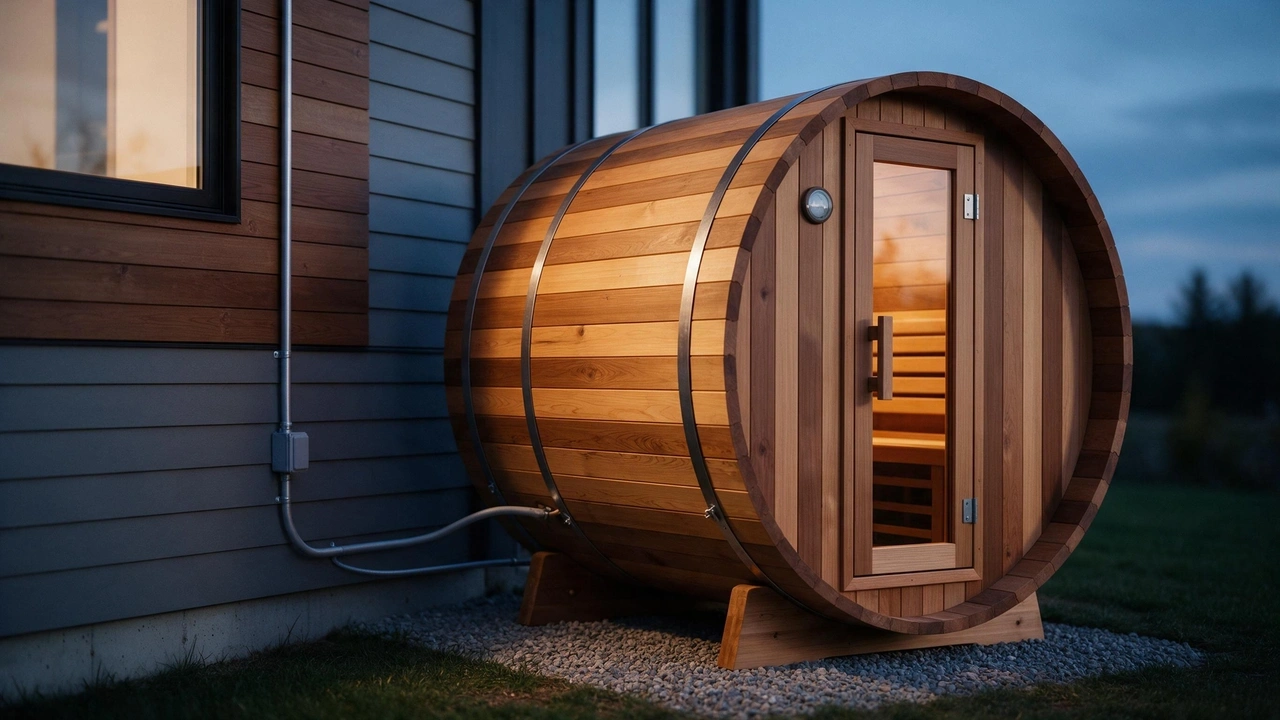
A typical 6 kW, 240-volt sauna heater needs a dedicated 30-amp circuit, 10-gauge copper wire, and a disconnect within sight. An 8 kW heater moves up to a 40-amp breaker and 8-gauge wire; a 9 kW unit needs 50 amps and 6-gauge wire. Local code and the heater manual always win.
- Typical heater
- 6–9 kW, 240 V, single phase
- 6 kW circuit
- 30 A breaker, 10 AWG copper
- 8 kW circuit
- 40 A breaker, 8 AWG copper
- 9 kW circuit
- 50 A breaker, 6 AWG copper
- Permit
- Usually a separate electrical permit
Some links on this page are affiliate links.If you buy through them we may earn a commission at no extra cost to you. We do not accept payment for rankings. Read the full disclosure.
| 6 kW | 9 kW | |
|---|---|---|
| Amps at 240 V | 25 A | 37.5 A |
| Typical breaker | 30 A | 50 A |
| Copper wire | 10 AWG | 6 AWG |
| Circuit cost | Lower | Higher: thicker wire, bigger breaker |
| Best for | Barrel saunas, 2–4 people | Larger cabins, faster heat-up |
The electrical circuit is the part of a sauna project that cannot be value-engineered later. You can change a bench, a door, or a heater brand; you cannot cheaply change a buried 10-gauge run that should have been 6-gauge. Size the circuit once, from the heater nameplate, and build the sauna around it.
What the circuit actually needs
A sauna heater is a fixed, high-draw appliance. In the US it is almost always 240 volts, single phase, and hardwired — no plug, no extension cord. The circuit has four parts: the breaker, the conductors, the disconnect, and the heater’s own wiring compartment. Each is sized from the heater’s kilowatt rating, not from the sauna’s square footage.
The nameplate is the authority. A “6 kW” heater may be rated at 6.0 kW at 240 V, or it may be a 6.3 kW element set that draws slightly more. The manual will list the supply voltage, amperage, minimum wire gauge, and maximum breaker size. Start there.
Heater size decides the breaker
The math is simple: amps equals watts divided by volts. A 6,000-watt heater at 240 volts draws 25 amps. An 8,000-watt heater draws 33.3 amps. A 9,000-watt heater draws 37.5 amps. The breaker is then chosen from the manufacturer’s table, which typically adds headroom for inrush and continuous operation.
| Heater | Amps at 240 V | Typical breaker | Copper wire |
|---|---|---|---|
| 3 kW | 12.5 A | 20 A | 12 AWG |
| 4.5 kW | 18.8 A | 25–30 A | 10 AWG |
| 6 kW | 25 A | 30 A | 10 AWG |
| 8 kW | 33.3 A | 40 A | 8 AWG |
| 9 kW | 37.5 A | 50 A | 6 AWG |
Two caveats. First, some manufacturers require 125% sizing for a continuous load. If the manual says so, size up one breaker and one wire step from the table — an 8 kW unit may need a 50-amp breaker and 6-gauge wire. Follow the nameplate, not the table. Second, voltage drop on a long outdoor run can require thicker wire than the table shows. A 100-foot run at 6 kW is not the same as a 25-foot run.
Wire, disconnect, and GFCI
Use copper conductors unless the manual explicitly approves aluminum. Most heater terminal blocks are small and rated for copper only, and aluminum needs a torque spec and antioxidant that installers rarely get right on a sauna.
A disconnect must be within sight of the heater. Some heaters have a built-in switch; others need a separate disconnect box. The point is that someone servicing the heater can kill power without walking back to the panel.
GFCI is the question that starts arguments. The National Electrical Code requires GFCI protection for many wet and outdoor locations, and sauna manufacturers increasingly require it. But a hardwired sauna heater is not a receptacle, and local interpretations vary. The safe move is to ask the inspector before buying the breaker. A GFCI breaker costs more and can nuisance-trip on some heaters, but it is the right answer in most wet locations.
Do you need a permit?
Assume yes. Electrical permits are usually separate from the building permit, and the inspection happens before the circuit is energized. The inspector will check the breaker size, wire gauge, grounding, disconnect, and clearances.
The building side is separate. A freestanding sauna may need a zoning setback check, a building permit above a certain footprint, and a foundation inspection. Some jurisdictions treat a small prefab sauna as an accessory structure with a simplified permit; others require full plans. Call the building department with the model and dimensions before you order concrete. The permit sequence is covered in backyard sauna permits.
What it costs
A straightforward 240-volt circuit — panel space available, 30–50 feet of wire, disconnect, and permit — typically runs $600–$1,500. The variables that push it higher are predictable:
- Long trench runs: $10–$30 per foot, plus conduit and burial depth.
- Panel upgrade: $1,500–$4,000 if the service cannot carry another 30–50 amps.
- Subpanel: $800–$2,000 if the sauna is far from the main panel.
- GFCI breaker: $80–$200 more than a standard breaker.
The heater itself is separate: $400–$1,500 for a 6–9 kW electric unit, more for a premium brand or a built-in control. For heater models and sizing, see best sauna heaters; for the monthly bill, see sauna running cost.
Mistakes that fail inspection
The most common failures are boring: a breaker larger than the heater’s maximum rating, a wire gauge chosen for the breaker rather than the heater, a missing disconnect, and a circuit run without a permit. The next tier is installation errors — conductors pinched in the heater compartment, a junction box buried behind cedar, or a run that is not protected from physical damage.
One more: buying the heater before checking the panel. A 9 kW heater on a 100-amp service with an electric range, dryer, and heat pump may require a service upgrade that costs more than the sauna. Do the load calculation first.
When to call an electrician
Call one for the panel check, the load calculation, the permit, and the final connection. Sauna heaters are not a DIY electrical project in the same way a light fixture is: the current is high, the location is wet, and the failure mode is a fire inside a wooden box. If you are comfortable running conduit and pulling wire, you can still save money by doing the trench and mounting; leave the terminations and inspection to a licensed electrician.
How to do it
- Read the heater nameplateFind the kW rating, voltage, and phase on the heater label or manual. Do not size the circuit from a product page summary.
- Check the panelConfirm there is space for a double-pole breaker and enough spare capacity. A load calculation may be required before adding a 30–50 amp circuit.
- Choose the wire routeMeasure from the panel to the heater, including the run outside. Voltage drop matters on long runs; thicker wire may be needed.
- Add the disconnectInstall a disconnect within sight of the heater, and follow the manual for clearances and wiring compartment access.
- Get the inspectionPull the electrical permit, complete the work, and have it inspected before the sauna is used.
Frequently asked questions
Can I plug a sauna heater into a normal outlet?
No. A 240-volt sauna heater draws 15–40 amps and must be hardwired on a dedicated circuit. A standard 120-volt outlet cannot supply it.
Do I need a GFCI for a sauna heater?
It depends on the heater, the location, and the local code. Many manufacturers and jurisdictions require GFCI protection for sauna equipment; others rely on a hardwired disconnect. Ask the inspector before you buy the breaker.
Can I run a 6 kW heater on a 30-amp breaker?
Usually yes: 6,000 watts at 240 volts is 25 amps, and 30 amps is the common manufacturer specification. Confirm against the nameplate and manual, because some units require 125% continuous-load sizing.
How much does the electrical work cost?
A straightforward 240-volt circuit runs about $600–$1,500. Long trench runs, a panel upgrade, or a subpanel can push it to $2,500–$4,000.
Do I need a separate electrical permit?
In most US jurisdictions, yes. Electrical permits are usually separate from the building permit and require an inspection before energizing the circuit.
Can I use aluminum wire?
Most sauna heater terminals are rated for copper only. Use copper unless the manual explicitly permits aluminum and the terminals are rated for it.
Sources
Some links are affiliate links.If you buy through them we may earn a commission at no extra cost to you. We do not accept payment for rankings. Read the full disclosure.