Cold plunge electricity cost per month
What a cold plunge chiller costs to run each month, using kW × duty cycle × 730 hours, with a rate table from 12 to 30 cents and an honest ice comparison.
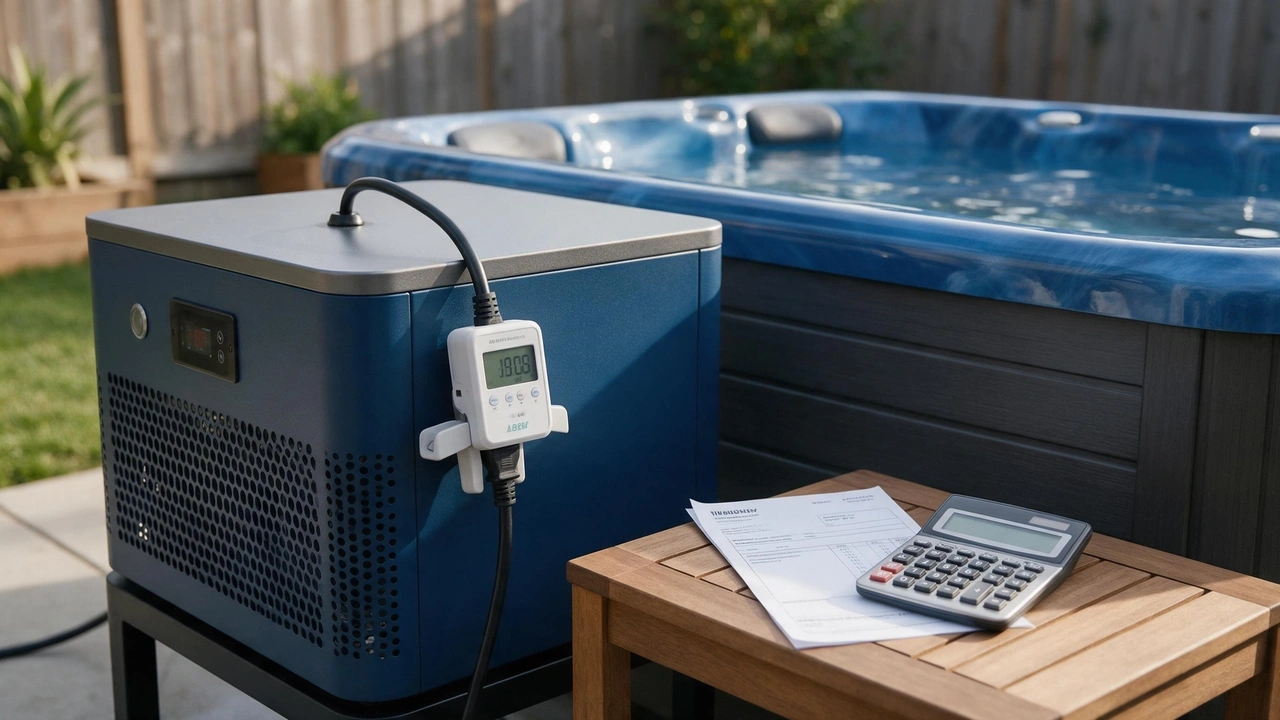
Chiller draw × duty cycle × 730 hours × your rate. A 0.5 kW chiller at 45% duty uses about 164 kWh a month: $20 at 12 cents, $28 at 17 cents, $49 at 30 cents. Heat and a loose lid push duty up.
- Typical range
- $12–$60 per month
- Formula
- kW × duty × 730 × rate
- 0.5 kW at 45%
- ≈164 kWh, ≈$28 at 17¢
- 0.8 kW at 60%
- ≈350 kWh, ≈$60 at 17¢
- Hidden load
- Circulation pump, 24/7
Some links on this page are affiliate links.If you buy through them we may earn a commission at no extra cost to you. We do not accept payment for rankings. Read the full disclosure.
| Chiller | Ice | |
|---|---|---|
| Upfront cost | $400–$2,500 | $0 |
| Monthly cost | $12–$60 | $60–$250 at 3–4 sessions a week |
| Temperature control | Holds a setpoint | Spikes and drifts |
| Effort | Clean the filter, check the setpoint | Buy, store, and haul ice |
| Best for | Daily use, 6+ months a year | Occasional use, small tubs |
A cold plunge chiller typically costs $12–$60 a month to run in the US, with most tubs landing near $25–$30 at the national average rate of about 17 cents per kWh. The number is not set by the chiller’s marketing claims. It is set by running watts, duty cycle, and how hard the unit has to fight the room it sits in.
Chiller electricity cost is the energy the compressor consumes while holding a water temperature, expressed in kilowatt-hours and multiplied by your all-in rate. Everything else — horsepower, gallons, setpoint — is an input to that one number.
The formula
monthly kWh = running kW × duty cycle × 730
monthly cost = monthly kWh × your rate
The 730 is hours in an average month: 24 × 30.4. Duty cycle is the fraction of the hour the compressor is actually running. A chiller that holds temperature easily might run 30% of the time; one in a hot garage with no lid may run 80%.
A worked example. A 0.5 kW chiller at 45% duty:
0.5 × 0.45 × 730 = 164.25 kWh
164.25 × $0.17 = $27.92
That is the whole calculation. The rest of this article is about choosing honest inputs.
Duty cycle is the number people guess wrong
Manufacturers quote cooling capacity at a specific water and ambient temperature, often 78–80°F. A plunge chiller holding 45°F in a 70°F room is working in a much narrower band, so it cycles. The same unit in a 95°F garage with the lid off may never cycle at all.
Duty cycle is driven by four things:
- Ambient temperature. The larger the gap between air and water, the faster heat enters through the walls and lid.
- Insulation. A rotomolded tub with foam insulation loses far less heat than a single-wall inflatable.
- The lid. An open or badly sealed lid is the largest avoidable loss. A lid also keeps debris out, which matters for the filter.
- Setpoint. 39°F is not 50°F. Every degree of temperature difference increases heat gain.
A practical way to estimate duty cycle without instrumentation: run the tub for a week, note the compressor’s on-time with a smart plug that logs energy, and divide. A $20 plug meter is more accurate than any rule of thumb. If you are still choosing a unit, the load math is in cold plunge chiller sizing.
The cost table
Nine combinations of draw and duty, at three US rates. Kilowatt-hours are rounded to the nearest whole number.
| Chiller draw | Duty | kWh/month | 12¢ | 17¢ | 30¢ |
|---|---|---|---|---|---|
| 0.3 kW | 30% | 66 | $7.90 | $11.20 | $19.70 |
| 0.3 kW | 45% | 99 | $11.80 | $16.80 | $29.60 |
| 0.3 kW | 60% | 131 | $15.80 | $22.30 | $39.40 |
| 0.5 kW | 30% | 110 | $13.10 | $18.60 | $32.90 |
| 0.5 kW | 45% | 164 | $19.70 | $27.90 | $49.30 |
| 0.5 kW | 60% | 219 | $26.30 | $37.20 | $65.70 |
| 0.8 kW | 30% | 175 | $21.00 | $29.80 | $52.60 |
| 0.8 kW | 45% | 263 | $31.50 | $44.70 | $78.80 |
| 0.8 kW | 60% | 350 | $42.10 | $59.60 | $105.10 |
Read the middle row first. A half-kilowatt chiller at 45% duty is the most common real-world case for an insulated tub in a temperate climate, and it costs about $28 a month at the US average. The 0.8 kW row at 60% is what a large tub in a hot garage looks like.
Climate is the biggest multiplier
The same chiller in Phoenix and Seattle is not the same appliance. Heat transfer through the tub wall is proportional to the difference between water temperature and air temperature. Holding 45°F in a 70°F room is a 25-degree gap. Holding 45°F in a 100°F garage is a 55-degree gap, more than twice the load.
That does not double the bill, because the compressor’s efficiency also changes and the duty cycle caps at 100%. It does routinely move a tub from the 45% row to the 60% row, and sometimes beyond what the unit can hold at all.
Shade helps more than people expect. A tub in direct sun absorbs radiant heat through the shell and lid. A cover and a shaded wall can be worth more than a bigger chiller.
Insulation and the lid
The lid is the cheapest efficiency upgrade you can make. Most heat enters from above, where the lid is thin and the seal is imperfect. A fitted insulated cover, a closed lid after every use, and a tub placed out of the wind will each reduce duty cycle.
Tub construction matters too. Rotomolded polyethylene with injected foam holds temperature well. An inflatable tub with a vinyl wall and an air gap is essentially a radiator. If you are choosing between a bigger chiller and a better-insulated tub, the tub usually wins on both purchase price and running cost. The water-care side of ownership is covered in cold plunge water care.
The pump is a second meter
The chiller is not the only load. A circulation pump running 24 hours a day at 40 watts adds:
0.04 kW × 730 = 29.2 kWh
29.2 × $0.17 = $4.96
That is small but not zero, and it is the reason some owners run the pump on a schedule rather than continuously. The trade-off is filtration and sanitizer circulation. A tub with no residual sanitizer and no flow grows biofilm quickly, so cutting pump hours to save $5 a month is usually a bad trade.
Ozone generators, UV lamps, and controllers add a few watts each. Together they are usually under $3 a month.
Ice versus chiller
The arithmetic favors the chiller faster than most people expect. Cooling 100 gallons of water by 25°F requires:
100 gal × 8.34 lb/gal = 834 lb of water
834 × 25°F = 20,850 BTU
20,850 ÷ 144 BTU per lb of melting ice = 145 lb of ice
That is about seven 20-pound bags for one session, before accounting for heat gain through the tub and the fact that the ice melts while you are getting in. At $5–$7 a bag, a single plunge costs $35–$50. Four sessions a week is roughly $600–$870 a month.
The ice comparison is not an argument against ice for everyone. If you plunge twice a month in a 60-gallon tub, bags are cheaper than a $1,200 chiller. If you plunge four times a week, the chiller pays for itself in two or three months of ice.
How to cut the bill
- Put the lid on. Every time, including between sessions.
- Shade the tub and the chiller. The condenser needs airflow, but not afternoon sun.
- Clean the condenser coils. Dust and pollen force the compressor to run longer.
- Raise the setpoint slightly. 45°F instead of 40°F is a real reduction in load and still cold.
- Insulate the gap. A stock tank or inflatable tub benefits from a foam board under the base and a fitted cover.
- Check the rate. A time-of-use plan can move the chiller’s running hours to cheaper periods, though a chiller runs around the clock and cannot fully shift.
The short version
Multiply running kW by duty cycle by 730 by your rate. A typical 0.5 kW chiller at 45% duty costs about $28 a month at 17 cents, and a large unit in a hot garage can pass $60. The variables you control are the lid, the shade, the setpoint, and the insulation. The one you cannot control is the weather.
Before you buy, compare the monthly number with the ice you would actually buy. Then compare it with the purchase price of the chiller, which is the larger cost by far. For the sauna side of the same calculation, see sauna running cost.
How to do it
- Find the chiller's running wattsUse the nameplate or the manufacturer's rated input, not the cooling capacity in horsepower. A 1/2 HP chiller often draws 450–600 watts while the compressor runs.
- Estimate the duty cycleDuty cycle is the share of the hour the compressor runs. A tub holding 45°F in a 70°F room might sit at 35–50%; the same tub in a 95°F garage can run 70–90%.
- Multiply by 730 hoursThere are 730 hours in an average month. Multiply running kW by duty cycle by 730 to get monthly kilowatt-hours.
- Apply your all-in rateAdd supply, delivery, and fees from your bill. The US average is around 17 cents, but the spread runs from about 12 to 30 cents or more.
- Add the pumpA 40-watt circulation pump running continuously adds about 29 kWh a month, or roughly $5 at 17 cents. It is not optional on a filtered tub.
Frequently asked questions
How much does a cold plunge cost to run per month?
Most chillers land between $12 and $60 a month at a US average rate near 17 cents per kWh. The low end is a small, well-insulated tub indoors; the high end is a large tub in a hot garage with a loose lid.
Does a cold plunge use a lot of electricity?
Less than a hot tub and far less than an air conditioner. A 0.5 kW chiller running 45% of the time draws about 164 kWh a month, which is roughly the same as a refrigerator plus a few loads of laundry.
Is it cheaper to buy ice than to run a chiller?
Only if you plunge a few times a month. Cooling 100 gallons by 25°F takes about 145 pounds of ice, so a single session can cost $30–$45 in bags. A chiller beats that after roughly two months of regular use.
Why does my chiller run all the time?
Usually ambient heat, a missing lid, a dirty condenser, or a setpoint below what the unit can hold. A chiller in a 95°F garage is fighting a much larger temperature difference than the same unit indoors.
Does a lower temperature cost much more?
Yes, roughly in proportion to the temperature difference. Dropping from 50°F to 40°F in a 90°F garage raises the gap from 40 to 50 degrees, about 25% more heat gain through the walls and lid.
Do I need a dedicated circuit for a chiller?
Many plunge chillers run on a standard 120-volt GFCI outlet, but larger units and heat-pump models may need 240 volts. Check the nameplate and have a licensed electrician install any new circuit.
Sources
Some links are affiliate links.If you buy through them we may earn a commission at no extra cost to you. We do not accept payment for rankings. Read the full disclosure.