What size chiller does a cold plunge need?
How to size a cold plunge chiller by volume, temperature drop, ambient heat, and pull-down time, with a gallons-to-horsepower table and the derating traps.
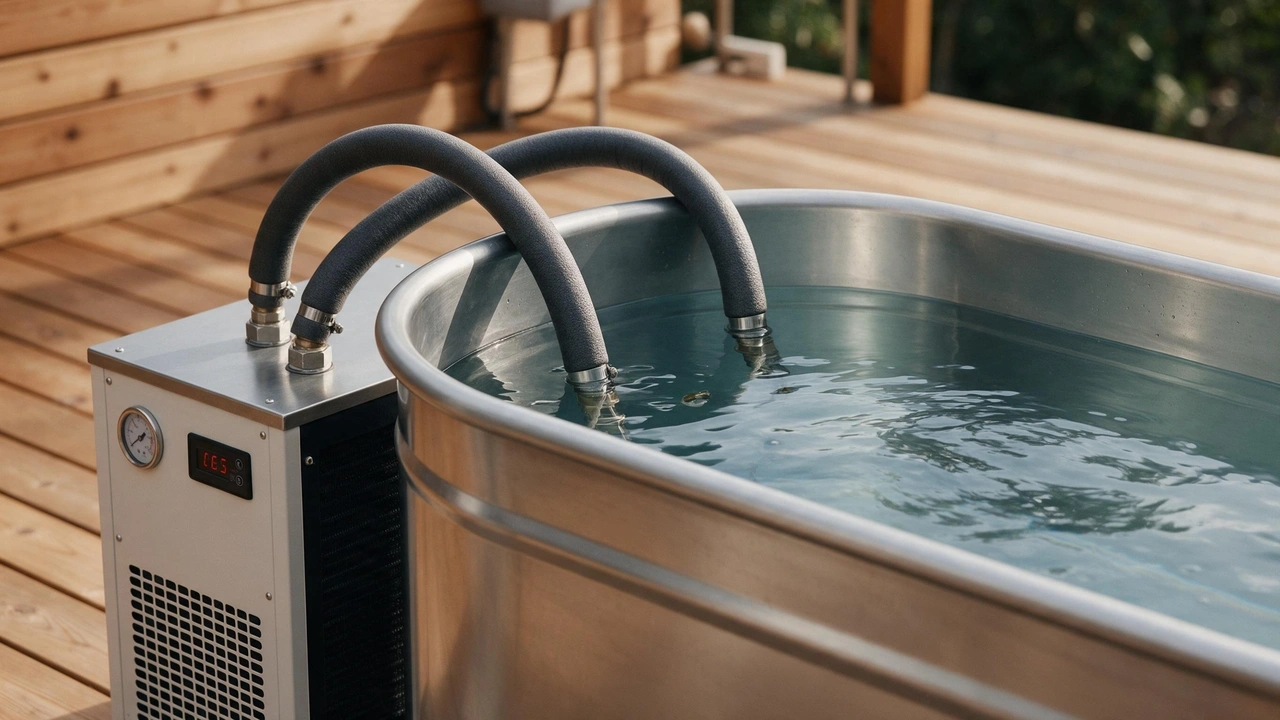
Size by BTU per hour removed, not gallons. A 100-gallon tub needs about 1,400 BTU/h to drop 20°F in 12 hours, and ambient gain in a hot garage can double that. Add 30% margin over the calculated load.
- Sizing basis
- BTU/h, not gallons alone
- Rule of thumb
- 1 HP ≈ 12,000 BTU/h nominal
- 100 gal, 20°F drop
- 16,680 BTU total
- Typical match
- 100 gal → 1/2 HP
- Biggest trap
- Ratings quoted at 78°F water
Some links on this page are affiliate links.If you buy through them we may earn a commission at no extra cost to you. We do not accept payment for rankings. Read the full disclosure.
| Aquarium chiller | Plunge chiller | |
|---|---|---|
| Rated at | Often 78–80°F water | Plunge temperatures, 40–50°F |
| Heat exchanger | Titanium, corrosion-resistant | Titanium or coated |
| Pump and filter | Usually separate | Often integrated |
| Housing | Indoor cabinet | Weatherproof shell |
| Price | Lower for the same nominal HP | Higher, but complete |
| Best for | Small indoor tubs, DIY builds | Outdoor tubs, daily use |
A 100-gallon cold plunge usually needs a 1/2 HP chiller rated around 6,000 BTU/h. A 50-gallon tub can get by with 1/4 HP. A 300-gallon tub wants 1 HP or a pair of smaller units. Those are starting points, not answers, because the number that decides the size is not gallons — it is how much heat the tub gains and how fast you want it gone.
Chiller sizing is the match between the heat load of your tub and the heat-removal capacity of the compressor at the water temperature you actually want. Get the load wrong and the unit runs forever; get the capacity wrong and it never reaches the setpoint.
Sizing starts with heat, not horsepower
Water has a specific heat of 1 BTU per pound per degree Fahrenheit. One gallon weighs 8.34 pounds. So raising or lowering a gallon of water by 1°F moves 8.34 BTU. That single fact lets you calculate the load for any tub.
Two loads matter:
- Pull-down load. The heat you must remove to get from tap temperature to your setpoint.
- Hold load. The heat that leaks back in through the walls, lid, and plumbing while the tub sits.
Most sizing conversations focus on the first and ignore the second. In a hot garage, the hold load can exceed the pull-down load within a day.
The arithmetic
total BTU = gallons × 8.34 × temperature drop
BTU per hour = total BTU ÷ hours allowed
A 100-gallon tub from 65°F to 45°F:
100 × 8.34 × 20 = 16,680 BTU
16,680 ÷ 12 hours = 1,390 BTU/h
So a 1/4 HP chiller rated at 3,000 BTU/h has more than twice the capacity needed — on paper. In practice it will not behave that way, because the rating is measured under favorable conditions and the tub is gaining heat the whole time.
That is why the same 100-gallon tub is usually sold with a 1/2 HP chiller. The extra capacity covers ambient gain, the inefficiency of a cold evaporator, and the recovery time after a person gets in and displaces warm water.
What 1/4, 1/2, and 1 HP actually mean
Horsepower is a compressor class, not a guarantee. As a nominal mapping:
| Class | Nominal capacity | Typical use |
|---|---|---|
| 1/4 HP | ~3,000 BTU/h | 40–75 gallon tubs, indoor |
| 1/2 HP | ~6,000 BTU/h | 75–150 gallon tubs |
| 1 HP | ~12,000 BTU/h | 150–400 gallon tubs |
| 1.5–2 HP | 18,000–24,000 BTU/h | Large tubs, commercial |
These are round numbers used across the industry, roughly one ton of cooling per horsepower. Two chillers with the same horsepower can differ by 30% in rated BTU because of compressor design, condenser size, and refrigerant. Always size from the BTU figure and the conditions it was rated at.
The sizing table
The table assumes a 20°F pull-down from about 65°F tap water to 45°F, a covered tub, and a 90°F ambient for the realistic column. The calculated column is pure thermodynamics; the realistic column applies a 2–3× field multiplier for heat gain and derating.
| Water volume | Chiller class | Nominal BTU/h | Calculated pull-down | Realistic, hot garage |
|---|---|---|---|---|
| 40–60 gal | 1/4 HP | 3,000 | 2–3 h | 6–10 h |
| 60–100 gal | 1/4–1/2 HP | 3,000–6,000 | 3–6 h | 8–14 h |
| 100–150 gal | 1/2 HP | 6,000 | 3–4 h | 10–16 h |
| 150–250 gal | 1/2–1 HP | 6,000–12,000 | 4–5 h | 12–20 h |
| 250–400 gal | 1 HP | 12,000 | 4–6 h | 16–24 h |
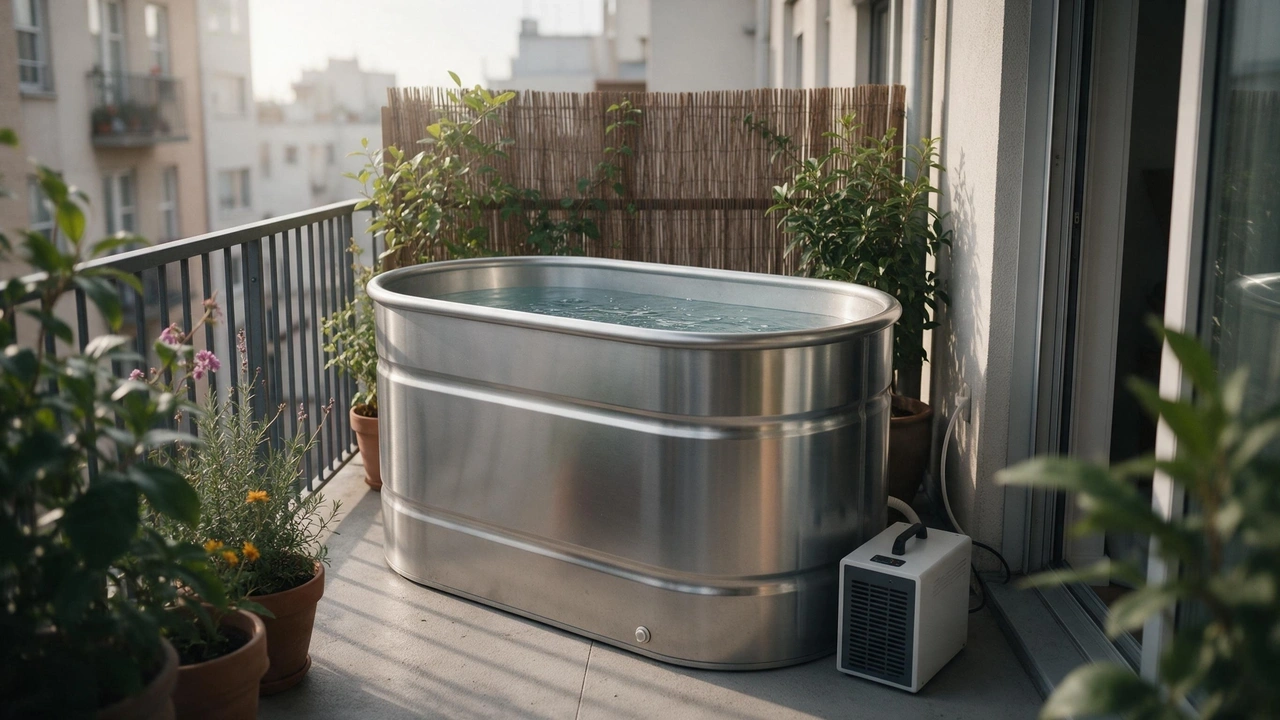
If the realistic column looks disappointing, that is the point. A chiller’s job is not to freeze a tub in an hour; it is to hold 45°F day after day. A unit that pulls down in six hours and then runs at 30% duty is better than one that pulls down in two hours and short-cycles. On a balcony, the smaller end of the table is the only realistic option; see cold plunge on an apartment balcony.
Aquarium chiller or plunge chiller
Aquarium chillers are legitimate hardware: titanium heat exchangers, decent compressors, and a price per BTU that is often lower than a plunge-specific unit. They are also designed for a different job. Their capacity is usually rated at 78–80°F water, where the compressor is efficient. At 45°F the same unit may deliver 60–75% of its nominal rating.
Plunge chillers are sold as a system: pump, filter, sometimes ozone or UV, a weatherproof housing, and a controller with a probe. You pay for integration and for a rating that is closer to the actual use.
The practical rule: an aquarium chiller is fine for a small indoor tub with separate filtration and a dry location. Outdoors, in a garage, or on a daily-use tub, buy the unit designed for the application. Weatherproofing and filtration are not optional in a backyard.
Why a small chiller runs constantly in a hot garage
A chiller moves heat from the water to the air. The hotter the air, the harder it is to reject that heat, and the lower the capacity. A 95°F garage also pushes heat into the tub through every surface.
Put a 1/4 HP unit on a 100-gallon tub in that garage and three things happen. Pull-down takes a day or more. The compressor runs at or near 100% duty. The condenser coil, already hot, cannot shed enough heat, so the unit’s internal protection may cycle it off and on.
The result is a chiller that never quite reaches the setpoint, runs constantly, and wears out early. The electricity cost climbs toward the top of the range in cold plunge electricity cost. Oversizing by one class is usually cheaper than replacing an undersized unit in two years.
Noise, flow, and placement
Chillers are not silent. Small units run around 45–55 dB(A) at three feet; larger heat-pump models can reach 60–65 dB. That is a refrigerator-to-dishwasher range, and it matters if the tub sits under a bedroom window.
Placement rules that actually matter:
- Airflow. Leave 12–24 inches of clearance around the condenser. A chiller in a closed cabinet overheats.
- Shade. Direct sun raises the condenser temperature and cuts capacity.
- Vibration. Set the unit on a pad, not directly on a deck that transmits sound into the house.
- Flow. Respect the minimum flow rate. Too little flow can freeze the evaporator; too much reduces the temperature drop across the unit.
- Drainage. Condensate and splash need somewhere to go.
The short version
Calculate the BTU load, add 30–100% for ambient and derating, and compare that to the chiller’s rated capacity at your target water temperature, not its brochure number. For most backyard tubs, 100 gallons pairs with 1/2 HP, 50 gallons with 1/4 HP, and 300 gallons with 1 HP.
Then read the manual for flow and clearance, and put the unit somewhere it can breathe. A well-matched chiller at 40% duty will outlast an oversized one that short-cycles and an undersized one that never stops. Water chemistry still matters as much as temperature; cold plunge water care covers the rest of the system.
How to do it
- Measure the water volumeUse the filled volume, not the tub's marketing capacity. A 100-gallon tub usually holds 80–90 gallons at a safe water line.
- Decide the pull-down timeTwelve hours is a reasonable target for a tub filled from tap temperature. Twenty-four hours is fine if you keep the tub cold between sessions.
- Calculate the BTU loadGallons × 8.34 × temperature drop in °F gives total BTU. Divide by the hours you are willing to wait for BTU per hour.
- Add ambient and marginAdd 30–100% for heat entering through the walls and lid, then compare against the chiller's rated capacity at your target water temperature.
- Check flow and noiseConfirm the chiller's minimum flow rate, fitting size, and decibel rating at three feet. A unit that needs a bigger pump is not the bargain it looked like.
Frequently asked questions
What size chiller do I need for a 100-gallon cold plunge?
A 1/2 HP unit rated around 6,000 BTU/h is the usual match. That gives a calculated pull-down of about three hours for a 20°F drop, and a realistic 10–16 hours in a hot garage once ambient gain is included.
Is 1/4 HP enough for a cold plunge?
For a small, well-insulated tub of 60 gallons or less indoors, yes. For a 100-gallon tub in a garage, a 1/4 HP unit will run almost continuously and may never reach 45°F in summer.
Does a bigger chiller cool faster?
Yes, roughly in proportion to its rated capacity, until the tub reaches the point where heat gain equals cooling output. Past that point, extra horsepower only shortens recovery time after you get in.
Why is my chiller rated in horsepower and BTU?
Horsepower describes the compressor class, and BTU per hour describes the heat it can remove. The BTU figure is the one that matters for sizing, but it is only valid at the water and ambient temperature the manufacturer tested.
Can I use an aquarium chiller for a cold plunge?
It can work for a small indoor tub with separate filtration. Aquarium units are usually rated at 78°F water, so their capacity at 45°F is lower than the headline number, and most are not weatherproof.
How long should a chiller take to cool a tub?
Overnight is the practical target: 8–16 hours for a typical tub. Faster than that is convenient but rarely worth the extra horsepower, because the chiller spends most of its life holding temperature, not pulling it down.
Sources
Some links are affiliate links.If you buy through them we may earn a commission at no extra cost to you. We do not accept payment for rankings. Read the full disclosure.