Does your panel have room for a sauna?
A practical load check for a sauna circuit: what 100 A and 200 A services carry, how the demand calculation works, and when a panel upgrade is the answer.
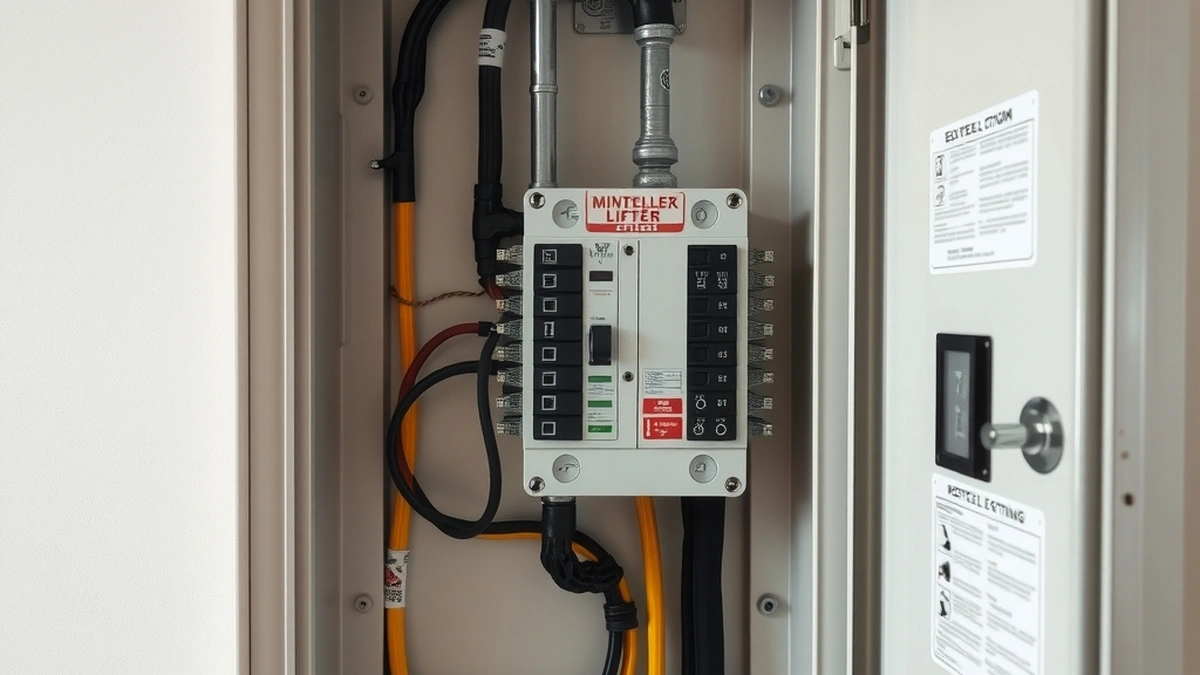
A 6 kW sauna heater draws 25 amps at 240 volts, so the panel needs about 30 amps of calculated spare capacity. A 100-amp service with an electric range, dryer, and heat pump usually has none; a house with gas appliances often does.
- 100 A service
- 24,000 VA at 240 V
- 200 A service
- 48,000 VA at 240 V
- 6 kW sauna
- 25 A, 30 A breaker
- 9 kW sauna
- 37.5 A, 50 A breaker
- Panel upgrade
- $1,500–$4,000
Some links on this page are affiliate links.If you buy through them we may earn a commission at no extra cost to you. We do not accept payment for rankings. Read the full disclosure.
| 100 A | 200 A | |
|---|---|---|
| Capacity at 240 V | 24,000 VA | 48,000 VA |
| Typical house | Under 2,000 sq ft, gas appliances | Larger or all-electric homes |
| Sauna fit | Often fits if heating and cooking are gas | Fits a 6–9 kW heater with room to spare |
| Upgrade trigger | Range, dryer, heat pump, and EV together | Rarely the limit; space in the panel may be |
| Upgrade cost | $1,500–$4,000 to reach 200 A | Not usually needed |
| Best for | Smaller homes, one big load at a time | All-electric homes, EV, hot tub, sauna |
A 6 kW sauna heater draws 25 amps at 240 volts. Whether the panel can supply that has almost nothing to do with how many breaker slots are empty and everything to do with what else in the house is drawing at the same time.
Panel capacity is the calculated load a service can carry, not the sum of the breaker handles and not the number printed on the main breaker alone.
What 100 A and 200 A actually mean
A service size is a current rating at 240 volts. Multiply the two to get volt-amperes:
100 A × 240 V = 24,000 VA
200 A × 240 V = 48,000 VA
That is the ceiling for the calculated demand, after demand factors — not a promise that you can run 24,000 VA of appliances at once.
The practical question is how much of that 24,000 or 48,000 VA is already committed. A 100-amp service in a small house with gas heat, a gas range, and a gas dryer may have 8,000–12,000 VA free. The same service in an all-electric house with a heat pump and an EV charger may have nothing.
The big loads that decide it
These are the appliances that eat a service. The numbers are typical; the nameplate is the authority.
| Appliance | Typical load | Note |
|---|---|---|
| General lighting and receptacles | 3 VA per sq ft | 2,000 sq ft = 6,000 VA |
| Small-appliance circuits | 1,500 VA each | Minimum two in a kitchen |
| Laundry circuit | 1,500 VA | One circuit |
| Electric range | 8,000–12,000 VA | Gas range is roughly zero |
| Electric dryer | 5,000–5,500 VA | Gas dryer is roughly zero |
| Water heater | 4,500–5,500 VA | Tankless can exceed 18,000 VA |
| Heat pump or A/C | 3,500–6,000 VA | Nameplate, plus air handler |
| EV charger | 7,200–11,520 VA | 30–48 amps continuous |
| Sauna heater | 6,000–9,000 VA | 25–37.5 amps at 240 V |
A sauna is a medium load. It is smaller than an EV charger, comparable to a range, and larger than a dryer. What makes it awkward is that it runs for an hour or two at full draw, usually in the evening, which is when the range and the dryer are also on.
How a load calculation works
The calculation starts with connected load in volt-amperes, then applies demand factors that reflect how a house actually behaves. The general lighting load is 3 VA per square foot. Small-appliance and laundry circuits add 1,500 VA each. Large appliances use their nameplate ratings.
For an existing dwelling, the optional method in Article 220 of the National Electrical Code works like this:
- Add the general lighting, small-appliance, laundry, and appliance loads.
- Take 100% of the first 10,000 VA.
- Take 40% of everything above 10,000 VA.
- Add the larger of the heating or cooling load at 100%.
- Divide by 240 volts to get amps.
That last step is the one people forget. A house with a heat pump is carrying a load that runs for hours in summer, and the code counts it at full value.
Your electrician runs the official version on the form your jurisdiction accepts. The arithmetic here shows why “you have two empty slots” is not an answer.
A worked example on a 100 A service
Take a 2,000-square-foot house with an electric range, an electric dryer, a 4,500 VA water heater, a dishwasher, and a 3-ton heat pump drawing 4,800 VA.
lighting and receptacles   6,000 VA
small appliance            3,000 VA
laundry                    1,500 VA
range                      8,000 VA
dryer                      5,000 VA
water heater               4,500 VA
dishwasher                 1,200 VA
total                     29,200 VA
Apply the demand factors: 10,000 VA at 100%, plus 40% of 19,200 VA (7,680 VA), gives 17,680 VA. Add the heat pump at 4,800 VA: 22,480 VA. Divide by 240: 93.7 amps.
That house is already at 94 amps of a 100-amp service without a sauna. A 6 kW heater adds 6,000 VA, bringing the total to 28,480 VA, or 118.7 amps. The panel does not have room, and no amount of breaker shuffling changes that.
Now switch the range, dryer, and water heater to gas. The appliance load drops to the dishwasher’s 1,200 VA. The same calculation lands near 64 amps before the sauna and 89.5 amps after it. The sauna fits, with about 10 amps of margin.
Same service size, opposite answer. That is why “100 amps” alone is not a diagnosis.
Signs the panel is already full
Some conditions are visible before the numbers:
- No two adjacent spaces for a double-pole breaker.
- A 60-amp or fuse-based service.
- A panel that is warm to the touch, rusted, or scorched.
- Double-tapped breakers, or several tandems piggybacking circuits.
- Lights that dim when the dryer or the heat pump starts.
- An EV charger added in the last two years without a service upgrade.
- A panel brand your electrician recognizes as a replacement candidate.
Ask about the last one directly. Some older panel lines have a reputation for breakers that fail to trip, and insurers increasingly ask about them. An electrician will tell you in five minutes.
Subpanel, upgrade, or load management
There are three ways to solve a capacity problem, and they are not interchangeable.
A subpanel adds breaker spaces and shortens the wire run to a distant sauna. It costs $800–$2,000 and does not add capacity. It is the right answer when the main panel has calculated room but no physical slots, or when the sauna is 100 feet away.
A service upgrade replaces the panel and often the meter and mast. A 100-to-200-amp panel change runs $1,500–$4,000; a full service change with new grounding and utility coordination can reach $2,500–$6,000. It is the permanent answer when the calculation is genuinely over the limit. The permit path is covered in backyard sauna permits.
Load management installs a controller that sheds the sauna when the range, dryer, or EV is drawing. It costs $400–$1,200 and keeps the service under its rating without a service change. A sauna is a good candidate because a 30-minute delay costs you nothing. The inspector and the utility both have to accept the device.
A fourth option is a smaller heater. Dropping from 9 kW to 6 kW removes 6,000 VA from the calculation, which is sometimes enough to clear a 100-amp service, at the cost of heat-up time.
What it costs
The electrical bill has four possible shapes:
- Circuit only: $650–$1,500 for a 30–50 amp outdoor circuit with a disconnect, permit, and inspection.
- Subpanel plus circuit: $1,500–$3,000, usually when the sauna is far from the main panel.
- Service upgrade plus circuit: $2,500–$5,500, when the calculation fails.
- Load controller plus circuit: $1,200–$2,500, when the service is close to its limit and a service change is not worth it.
These are site-dependent: a trench, a finished basement ceiling, or a concrete patio adds labor no table captures. The circuit specification itself is in sauna electrical requirements, and the installed total is in sauna installation cost.
The short version
Get the load calculation before you buy the heater. A 6 kW sauna needs 25 amps and a 30-amp breaker; the question is whether the service has 30 amps of calculated room left after the range, dryer, heat pump, and EV.
If it does, you need a circuit. If it does not, you need a subpanel, a service upgrade, a load controller, or a smaller heater, in roughly that order of cost. A licensed electrician and the local building department decide which one is acceptable, and the answer is cheaper to learn before the sauna arrives than after.
Frequently asked questions
Can I add a sauna to a 100-amp panel?
Often yes, if the calculated load leaves 30 amps free. The answer depends on the range, dryer, water heater, heat pump, and EV charger, not on the panel's brand or the number of empty slots. An electrician has to run the calculation.
How many amps does a sauna heater use?
A 6 kW heater draws 25 amps at 240 volts, an 8 kW unit 33.3 amps, and a 9 kW unit 37.5 amps. Breakers are sized from the heater nameplate, typically 30, 40, and 50 amps respectively.
Does a subpanel add capacity?
No. A subpanel adds breaker spaces and shortens wire runs; it does not increase the service's calculated capacity. If the main service is full, a subpanel just gives the overload a tidier address.
How much does a panel upgrade cost?
A 100-to-200-amp panel replacement typically runs $1,500–$4,000. A full service change that includes the meter, mast, grounding, and utility coordination can reach $2,500–$6,000, plus the sauna circuit.
Can I use a load controller instead of upgrading?
Sometimes. A load-management device sheds the sauna when the range, dryer, or EV charger is drawing, which can keep the service under its limit. Installed cost is roughly $400–$1,200, and the inspector has to accept the approach.
Will the electrician need to see the heater first?
Yes. The nameplate gives the kW rating, voltage, and maximum breaker size, and the manual gives the clearance and wiring requirements. Buy the heater after the load calculation, not before.
Sources
Some links are affiliate links.If you buy through them we may earn a commission at no extra cost to you. We do not accept payment for rankings. Read the full disclosure.