DIY chest freezer cold plunge: safe or not?
A realistic chest freezer cold plunge build: food-grade liner, controller, GFCI, condensation, compressor duty, filtration, costs, and the failure modes.
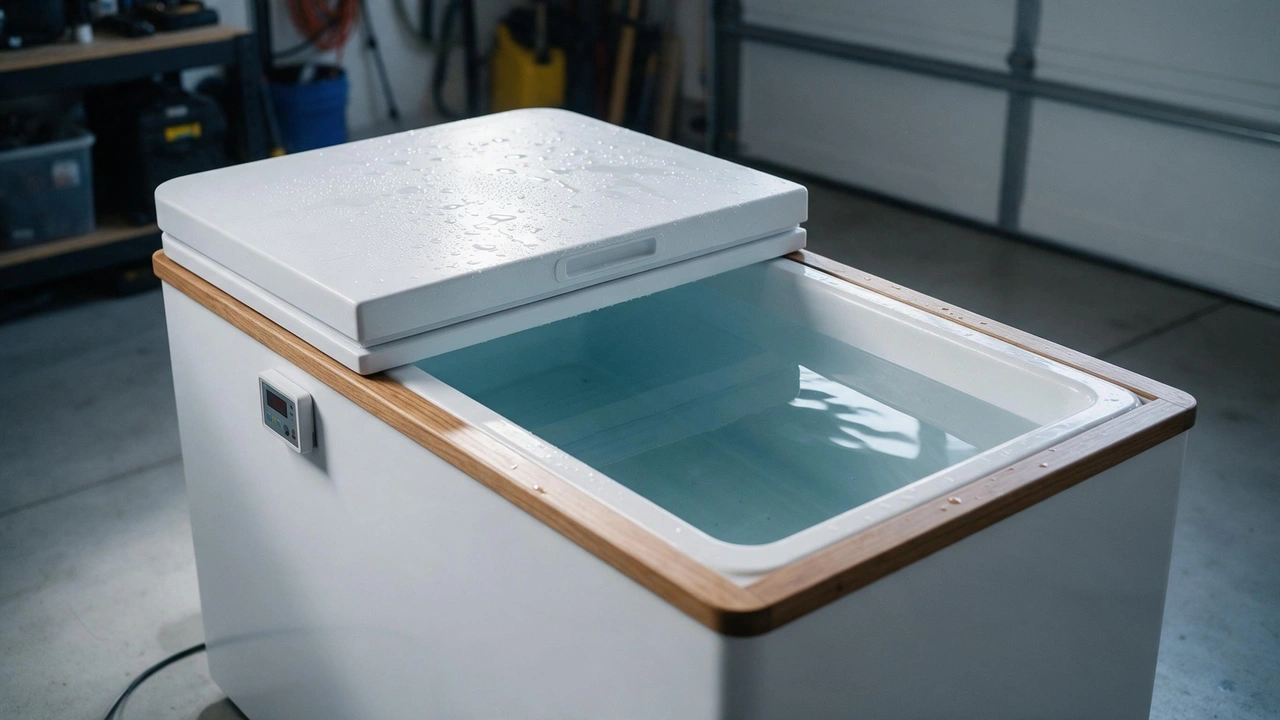
A chest freezer can make a cold plunge for $400–$1,200 with a food-grade liner, external controller, GFCI, filtration, and sanitizer. But the compressor is not built for continuous 40°F duty, and used units fail.
- Typical build cost
- $400–$1,200
- Usable volume, 15 cu ft
- About 80 gallons
- Filled weight, 80 gal
- ≈780 lb with the freezer
- Biggest risk
- Unsealed liner and condensation
- Electrical
- GFCI, licensed electrician
Some links on this page are affiliate links.If you buy through them we may earn a commission at no extra cost to you. We do not accept payment for rankings. Read the full disclosure.
| DIY freezer | Manufactured tub | |
|---|---|---|
| Cost | $400–$1,200 | $1,000–$5,000 |
| Insulation | Good walls, weak lid | Designed for cold water |
| Filtration | Added separately | Often integrated |
| Warranty | None after modification | 1–5 years |
| Repair | Compressor failure ends the build | Parts available |
| Best for | Handy owners, tight budgets | Daily use, low maintenance |
A chest freezer cold plunge can work, and it can also turn into a tub of lukewarm water with a dead compressor and a warranty voided by a hole saw. The difference is not the idea. It is the liner, the controller, the electrical protection, and an honest expectation of how long a freezer lasts.
A DIY chest freezer cold plunge is a chest freezer whose interior has been lined for potable water, whose compressor is switched by an external thermostat, and whose water is filtered and sanitized like a small pool.
What the build actually is
The freezer supplies an insulated box, a lid, and a compressor with an evaporator coil built into the walls. Everything else is added.
That last detail matters. On most chest freezers, the refrigerant lines run through the cabinet walls and the lid. A screw or drill bit in the wrong place releases the charge, and the unit is scrap.
Volume, weight, and usable fill
Freezer capacity is quoted in cubic feet, and one cubic foot is 7.48 gallons.
15 cu ft × 7.48 = 112 gross gallons
112 × 0.75 fill = 84 usable gallons
A 75% fill line leaves room for displacement and splash.
Weight follows the same 8.3 pounds per gallon rule as any tub. An 84-gallon fill is 697 pounds of water, plus 100–140 pounds for the freezer itself. Call it 800–850 pounds on 5–6 square feet. That is a garage or slab load, not a second-floor deck load.
The liner decides whether it is safe
The bare interior of a chest freezer is not a potable water surface. It has seams, a drain plug, plastic edges, and a finish that was never intended for skin contact or drinking-water standards.
Three liner approaches are common:
- HDPE sheet. Cut and fit panels, seal the seams with neutral-cure silicone.
- Food-grade LDPE or a potable-water epoxy coating. Easier to apply, less resistant to scraping.
- EPDM pond liner. Cheap and fish-safe, but not rated for potable water and prone to trapping water in the folds.
Whichever you choose, seal the factory drain plug. It is designed to let meltwater out; in a plunge it lets tub water onto the floor slowly enough to damage it before you notice.
Use silicone labeled for food contact and free of mildewcide; the mildew-resistant version leaves a residue you do not want in the water.
Temperature control and compressor duty
A chest freezer holds 0°F. A cold plunge holds 40–50°F. The gap is bridged with an external thermostat: a probe sits in the water, and the controller switches power to the freezer when the water warms above the setpoint.
Two controller specs matter. It needs a compressor delay (also called anti-short-cycle), which prevents the compressor from restarting immediately after a power cut. And its relay must be rated for the freezer’s starting current, not just its running watts.
A 15-cubic-foot freezer’s compressor draws roughly 150–250 watts while running. At 50% duty:
0.2 kW × 0.5 × 730 = 73 kWh
73 × $0.17 = $12.41 a month
At 90% duty in a hot garage, the same unit uses about 131 kWh, or $22 a month. That is cheaper than a dedicated chiller of similar capacity, which is the real appeal of the build; sizing is covered in cold plunge chiller sizing. The catch is that the compressor was not designed to run that often. A freezer cycles briefly at 0°F because the load is small. Water at 45°F in a 95°F garage is a different job, and the compressor may run for hours.
That is why a used freezer is a gamble: you cannot inspect the compressor, the charge, or the evaporator buried in the walls. If it fails in August, the liner and controller are the only salvageable parts. Cold plunge electricity cost covers the running math in more detail.
Condensation, insulation, and the lid
Cold water in a warm room produces condensation, and a freezer has several cold bridges: the rim, the gasket, the drain plug, and the liner seams.
Water collects under the lid and runs down the walls; in a humid garage, the cabinet corners can sweat too. Left alone, it rusts the shell, grows mildew in the gasket, and damages the floor.
Three fixes:
- Set the unit on a drip tray or a pressure-treated pallet. Air can move under it, and the tray catches what runs down.
- Insulate the lid. A layer of rigid foam board on the underside, sealed at the edges, reduces both heat gain and condensation.
- Control the room. A dehumidifier or a fan does more than any coating. Keep the lid closed between sessions.
The lid is the weakest insulation in the system: a thin steel skin with foam behind it, and a gasket that flattens over time. A replacement gasket is cheap; a warped lid is not.
Filtration and sanitation
A freezer has no filtration and no sanitizer. Adding water does not add either.
The minimum system is a small pump, a 20–50 micron cartridge filter, and a sanitizer with a measurable residual. Turnover should move the full volume every one to two hours. For an 80-gallon tub, that is 40–80 gallons per hour of actual flow.
Test sanitizer and pH twice a week, shock weekly, and change the water every 2–4 weeks. The lid traps warmth and humidity, so a freezer tub can grow biofilm faster than an open tub at the same temperature. The full routine is in cold plunge water care.
The cost breakdown
| Item | Budget | Typical |
|---|---|---|
| Used chest freezer, 15–20 cu ft | $150 | $350 |
| Food-grade liner or potable epoxy | $60 | $150 |
| Temperature controller | $30 | $50 |
| GFCI outlet or circuit | $0–$150 | $250 |
| Pump and filter | $60 | $110 |
| Lid insulation, seal, hardware | $40 | $80 |
| Test kit and sanitizer | $30 | $50 |
| Total | $370–$520 | ≈$1,040 |
The low end assumes an already-owned freezer and an existing GFCI outlet. A new 15-cubic-foot freezer is $500–$900, and a new dedicated circuit can add $300–$600, pushing a premium build past $1,500.
Safety rules that are not optional
- GFCI protection on the circuit. No extension cords or cords across a wet floor. A licensed electrician installs any new outlet or circuit.
- Never drill blind. Refrigerant lines and wiring run through cabinet walls. Get the line diagram or do not put a fastener in.
- Food-grade liner only. The bare interior is not a potable water surface.
- Seal the drain plug and every seam. A slow leak is invisible until the floor is ruined.
- Secure the lid. A chest freezer is an entrapment hazard for children. Add a lock or remove the latch.
- Keep the controller and probe cable out of splash range. Water and line voltage do not mix.
- Check the floor. 84 gallons is about 700 pounds of water before the freezer.
- Never use a freezer that held fuel, pesticides, or unknown material. A liner does not undo contamination.
- Leave clearance around the condenser. A boxed-in unit overheats and shortens its own life.
The short version
A chest freezer cold plunge costs $400–$1,200 and works when the water touches only a food-grade liner, the circuit is GFCI-protected, the compressor is switched by a controller with a delay, and the water is filtered and sanitized. It runs cheaper than a dedicated chiller and dies sooner than a manufactured tub.
If you want a tub you can ignore for a month, buy one built for the job. If you want a project that costs half as much, the freezer is a reasonable starting point — with the electrical work left to an electrician and the liner treated as the most important part of the build.
How to do it
- Pick the freezer and measure usable volumeA 15 cubic foot chest freezer is about 112 gallons of gross space, but a safe fill line leaves 75–85 gallons. Measure the interior, not the label.
- Line and seal it for potable waterUse food-grade HDPE, LDPE, or a potable-water epoxy. Seal the drain plug and every seam with neutral-cure silicone that contains no mildewcide.
- Add the controller and the circuitUse an external thermostat with a probe in the water and a compressor delay. Have a licensed electrician confirm GFCI protection on the circuit.
- Install filtration and a sanitizer routineAdd a small pump and a 20–50 micron filter, then choose chlorine, bromine, or hydrogen peroxide and test twice a week.
- Insulate the lid and plan for condensationAdd foam board to the lid, replace the gasket if it is stiff, and set the unit on a drip tray with a dehumidifier or ventilation nearby.
Frequently asked questions
Is a chest freezer cold plunge safe?
It can be, if the water touches only a food-grade liner, the circuit is GFCI-protected, the lid is secured, and the controller is kept away from splash. The unsafe versions are bare freezer interiors, extension cords, and unsealed seams.
How much does a DIY chest freezer cold plunge cost?
Most builds land between $400 and $1,200. A used 15-cubic-foot freezer is $150–$400, the liner $60–$200, the controller $30–$60, and the electrical work $0–$400 depending on what already exists.
What size chest freezer do I need?
A 15-cubic-foot freezer gives roughly 80 usable gallons, enough for one adult to submerge. A 20-cubic-foot unit gives about 105–110 gallons. Smaller than 12 cubic feet is cramped for full immersion.
Will the freezer compressor burn out?
It may. A freezer is designed to cycle at 0°F, not to hold 40°F water in a hot garage. Continuous duty, a dirty condenser, and a loose lid all shorten its life, and a failed compressor usually ends the project.
Can I use the freezer's own thermostat?
Most freezers cannot be set to 40–50°F, so builds use an external controller that switches the power. That controller needs a compressor delay to prevent short cycling, and the freezer's own protection should stay intact.
How often do I change the water?
Every 2–4 weeks with a cartridge filter and a sanitizer residual, the same as any small tub. A freezer lid traps humidity and warmth, so test sanitizer and pH twice a week rather than trusting the calendar.
Sources
Some links are affiliate links.If you buy through them we may earn a commission at no extra cost to you. We do not accept payment for rankings. Read the full disclosure.